Showing posts with label IT News. Show all posts

Wednesday, March 30, 2011

Bump for iPod

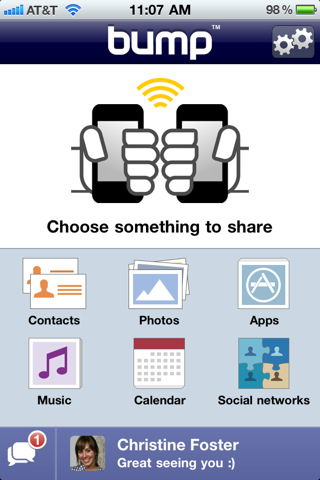
What's Bump?

Bump™ makes sharing with people as simple as bumping two phones together. Just pick what you want to send, then hold your phones and gently bump hands with another Bump user. And now, you can message with your friends who aren't near you -- just add them as a friend inside of Bump and start messaging immediately -- it's kind of like a long-distance "virtual bump".

Use Bump for free texting: send messages anytime, complete with instant push notifications.

Share photos, apps, music, messages, locations, contacts, calendar events; become friends on Facebook, Twitter, and LinkedIn; compare mutual friends, and more.

Bump works cross-platform between iPhone, iPad, iPod, and many other phones.

What's new in version 2.4.1:
+ Landscape keyboard!
+ Delivery failure alert: know if your message doesn't get through
+ Faster scrolling

What's new since version 2.2:
+ App Sharing! Select your favorite apps and bump them to a friend. They'll get direct links to download the apps from iTunes.
+ Send messages to friends who aren't near you by adding them as a friend inside of Bump -- it's kind of like a long-distance "virtual bump".
+ Music Sharing! Select songs on your device and bump them to a friend. They can stream them for free from Youtube, listen to iTunes previews, or buy them on iTunes.

Source: iTunes.com

CarFinder for BB

Now here’s an app that would come in handy for a guy like me. Ever find yourself at that big sporting event, or perhaps you were doing some shopping at the mall, and for the life of you, you can’t remember where you parked your vehicle? This has happened to me more than once, and it usually ends up with a fit of historical laughter as I weave my way in and out of cars, hoping to find the one that brought me. Thankfully, the crafty developers at VisionQuest Innovations have put together a new BlackBerry app called VQ CarFinder.

All you need to get this working is a GPS-enabled BlackBerry running OS 4.5 or later… and Bluetooth built-in to your vehicle. If you don’t have Bluetooth in your vehicle, you can purchase a VQ Bluetooth Car Charger to help things along.

The great thing about this app is it is pretty darn automatic. When you start up your vehicle, Bluetooth automatically kicks in. The VQ CarFinder app picks up the signal and launches GPS to track your current location. When you turn your vehicle off, the Bluetooth signal stops, at which point the app pinpoints the last location of the Bluetooth signal. Now, to find your car, all you have to do is launch the VQ CarFinder app, and a handy map will show you where you are, and where your ride is. Easy!

You can pick up VQ CarFinder for $9.99 in App World. For more info hit up http://www.4carfinder.com/ from your desktop or BlackBerry handheld.

Note: There’s also a cool contest goin on over at 4carfinder.com. Tell them your parking horror story as a video and you could win a shiny new Berry.

By: James

Fruit Ninja! (for iPod/iPad)


What is Fruit Ninja?

Swipe your finger across the screen to deliciously slash and splatter fruit like a true ninja warrior. Be careful of bombs - they are explosive to touch and will put a swift end to your juicy adventure!

Fruit Ninja also uses OpenFeint, so players can unlock achievements and shoot for the top of the global leaderboards while racking up OpenFeint points.

Your success will also please the wise ninja Sensei, who will accompany your journey with wise words and fun fruit facts.

Fruit Ninja is the messiest and most satisfying fruit game ever!

Plant VS Zombies for Mac

Who knew zombies were omnivores? Plants vs. Zombies presents a cuddlier take on these murderous undead. They really want to eat your brains, but they shamble in a straight path to your house, snacking on landscaping that gets directly in their way. Thankfully, your garden fights back, with pea-shooting plants, exploding peppers, giant flytraps, and dozens more. You’ll plant these defenses to stop the zombies in a sly, simple game with compelling strategy.

Gamers will recognize that Plants vs. Zombies reshapes the “tower defense” genre, strategy games where you set up automated turrets to protect from assailants. But Plants vs. Zombies both simplifies that premise and adds a lot more depth, making it stand out in that current-fad genre.

You’ll buy new plants by harvesting sunlight icons that drift down from the sky or are generated by certain plants. At first, you’ll only have a choice of a few plants, and the same kind of zombie will keep attacking. But you’ll earn a new plant type at the end of nearly every level, and you’ll face a new zombie in the next round, eventually battling dozens. We had fun developing favorite strategies for various situations, such as using plants that freeze fast-moving zombies or positioning magnetized plants to pull off zombies’ protective bucket helmets.

Both the plants and zombies are lovingly presented, with sharp illustrations and sound effects. Some zombies wear traffic cones as helmets and are tougher to stop. Some run and pole-vault over the first item in their path. All are a joy to discover.

While the game’s premise stays the same, each zombie and level twists the situation. You’ll battle swimming zombies in a backyard pool, have your visibility hampered by fog, and even position plants in pots to protect your roof. Even the method of planting gets broken up; some levels skip the sun-collecting system and just shuffle plants along a conveyor belt. Other times, you’ll hit zombies with a mallet.

And the twists just keep coming. A virtual-pet minigame rewards you for tending sprouts daily. And puzzle-based levels take even more thought; we especially liked playing as the zombies and attacking the plants. These and many more variations keep the game engaging.
You'll smile at the clever Plants vs. Zombies animation and sound, but compelling strategy rules give it even deeper roots.


Plants vs. Zombies
COMPANY: PopCap Games
CONTACT: www.popcap.com
PRICE: $19.95
REQUIREMENTS: 1.66GHz Intel Core Duo or faster Intel processor, Mac OS 10.4.11 or later

Source: maclife.com

Tofu for Mac

Tofu is a novel application to address the common problem that people don't like reading text on the screen.


Why is that anyway? I believe there are two main reasons: line width and visual instability.

Text is usually very wide on the screen, which makes going from the end of one line to the beginning of the next difficult. That's why newspapers have narrow columns: It makes them faster to read.

So why not just take a normal window and make it narrower, scrolling down as you need? Well, there are usually a lot of lines in a text, and all look more or less the same, so if they move past your eyes vertically, they are difficult to keep track of. The text doesn't feel stable, and you get lost easily.

In Tofu, text is arranged in columns, and each column is only as high as your window. So lines are nice and narrow, and they don't move about vertically. You just scroll from column to column horizontally, and feel more in control. Bonus: your text is now also in easy-to-digest chunks.

Tofu also includes some other useful features to make reading easier. To search for a word, simply start typing it; Tofu will find to the next matching instance as you type. There's a system-wide Service, so you can quickly move some text from a web page into Tofu. And it lets you navigate using your voice, so you can literally sit back and read.

miSoccer iPod Dock

An iPod dock provides a convenient way to charge and sync an iPhone or iPod. There are numerous iPod docks on the market, however, most people are interested in purchasing docks that are creative-looking while still providing an effective charge


A company called Speakal created the miSoccer iPod dock. The CEO created the docks as homage to the World Cup Championship. The company wanted to introduce an innovative and quality audio product by releasing the miSoccer iPod dock.

The miSoccer iPod docks works like every other speaker, the only exception is it looks like a soccer ball or football depending on where you're located in the world.

The dock has a self-contained 2.1 sound system. It also has a 15 W subwoofer as well as two full range drivers for stereo sound. The dock's best feature is the 23+ watts of high quality sound that it's able to produce.

The miSoccer iPod dock is perfect for sports fans are children who like to play soccer. It is possible to charge any iPod model with the miSoccer dock, but there’s still speculation on whether or not the dock is compatible with the iPhone.

The miSoccer iPod dock can be used with DVD players, mobile phones, MP3 players, and PMP thanks to a 3.5mm jack. It also has a remote control.

The dock is available and three color combinations — black and white, red and white, or blue and white. Consumers can expect to pay about $120 for the iPod dock.

Via Technabob

Countdown to the Weekend with a Weekend Clock

If your the sort of person who spends most of the week counting the hours until the weekend, then you need one of these fun weekend clocks.

You can set the weekend clock for whenever your weekend begins, for example set it for 5pm on a Friday and it will count down the hours, minutes and seconds until the weekend.

If you want one they will be available to pre-order shortly for £19.99 about $28 from Lazybone.


This is a Syndicated post from Geeky Gadgets.

Shutter Buddy

When children are very young, parents tend to have a desire to capture as many moments as they possibly can. The best way to capture the moments is through photography. Shutter Buddy provides a way for parents to capture moments by offering a device that will keep the child looking in the camera direction long enough to get a good picture.

The Shutter Buddy is a camera accessory that comes in the form of an interesting checkerboard hood that is meant to capture the attention of a baby long enough to get a shot.

The shutter buddy is easy to use, lightweight, and easy to store. The product is great for parents who want to get their child to focus.

Capturing a smiling picture of a child is not always easy and normally requires considerable effort fro the parent, but the Shutter Buddy makes baby photography much easier. The Shutter Buddy is actually recommended for newborns up to 9 months of age, although it may work on older toddlers.

Parents can expect to pay $19 for the Shutter Buddy.

Pop Art Toaster

Having to start your day with a breakfast of coffee and toast seems to be quite common. After all, having the same daily routine can become quite boring after some time. Even simple changes can easily bring some breath of fresh air to some dull routine. When it comes to breakfast, this Pop Art Toaster might help inject some unique touch to your daily toast for breakfast.

The Pop Art Toaster provides you with a way to inject some art into your toast. It features several burn templates that can be installed into the toaster to inject some humor into your day. You can have a toast that says “Bite Me” or one that says, “Ugh”. Or you might prefer having some funny face imprinted on your toast, that is also possible. The Pop Art Toaster comes with a 50’s inspired toaster design along with easily removable art templates. This bread toaster also comes with a handy coffee warming plate to boot. The Pop Art toaster is available at ThinkGeek for US$45.

Source: gadget.com

Sociable Teddy Bear Robots by Fujitsu


At a recent trade expo, Fujitsu unveils their “social robots” that appear as innocent teddy bears on the outside, but have a pretty sophisticated design on the inside. The bears have 12 joints, multiple touch sensors, microphones, speakers, and accelerometers.

The robots have sensors built into their noses, which detects human movement and responds to certain actions. Waving your hand in front of the bear, for instance, would make it wave back at you. They are also able to interact with you through face recognition and constant tracking of where you are. Apart from waving its hand, the Social Robot can also laugh, move its feet, look from left to right, and hundreds of other pre-programmed patterns of behavior.

The Social Robot by Fujitsu will be sold mainly in nursing homes and schools, according to the manufacturer.

Source: gadget.com

New Intel 320 SSD: Smaller, cheaper, less reliable?

Hurrah! SSDs are getting less expensive. And the reason is our old friend, Intel co-founder Gordon E. Moore and his eponymous law -- Moore’s Law forecasts that the density of integrated circuits doubles every two years -- which usually causes falling prices. Read how Intel's new 320 Series SSDs are an unusual illustration of how this works, in The Long View...

SSDs are following the classic pattern. Let's use Intel's SSD product history as an example: Its first generation drives used 50nm process technology and were eye-wateringly expensive. Its followup X25-M G2 drives used a 34nm process and were (relatively) inexpensive -- something around $2 per GB. Now we're finally seeing the next jump in density: 25nm.

This is going to drive street prices of mainstream SSDs down, say, 20% soon -- dropping even more once production volumes ramp up. I'm pleased to see that my worst fears about Intel's 25nm fab seem to be unnecessary. Here's why: read on...

To continue reading, register here and become an Insider. You'll get free access to premium content from CIO, Computerworld, CSO, InfoWorld, and Network World. See more Insider content or sign in.

Microsoft extends system management to Apple, Android devices

InfoWorld - Microsoft is recognizing enterprise realities with its new accommodations for rivals' smartphones in an upcoming version of System Center Configuration Manager, an industry analyst said on Thursday.

Beta 2 of System Center Configuration Manager 2012, released this week, enables IT to manage user experiences on devices ranging from Microsoft's own Windows Phone to Symbian, Apple iOS, and Google Android-based units. Microsoft's multi-vendor moved was lauded by analyst Fred Broussard, research director at IDC.

[ Learn how to manage iPhones, Androids, BlackBerrys, and other smartphones in InfoWorld's 20-page Mobile Management Deep Dive PDF special report. | Keep up on key mobile developments and insights via Twitter and with the Mobile Edge blog and Mobilize newsletter. | Keep up with Paul Krill on his Twitter feed.]

"Microsoft along with the rest of infrastructure software market vendors are seeing more enterprises having to deal with endpoints other than the traditional desktop or laptop computer," Broussard said. "At the same time, vendors are seeing customers move toward having broader acceptance of devices like iPads or BlackBerries or Android phones in the enterprise that might access corporate networks and data. It is in the company's best interest to ensure that the corporate data is protected, yet the users of IT services have access to devices that allow them to be productive. Products like System Center Configuration Manager are now more being pulled in this direction of managing devices like iPads along with managing a laptop or desktop. I do think this is the smart direction for Microsoft to take with this product."

Previously, System Center Configuration Manager only dealt with Windows devices. The multi-vendor approach is in response to a need to secure a wider variety of devices and platforms, a Microsoft representative said. Microsoft's Exchange ActiveSync protocol is leveraged by System Center Configuration Manager; users can be given access to corporate email while company information is protected.

System Center Configuration Manager 2012 is slated for general availability later this year. Downloadable at Microsoft's website, Beta 2 embraces a consumerization trend in IT without giving up control over corporate assets, Microsoft said on its System Center Configuration Manager Web page. "System Center Configuration Manager 2012 Beta 2 helps you empower your employees to use the devices and applications they need to be productive while maintaining corporate compliance and control. In today's workplace, the boundaries between work and life have blurred. People expect consistent access to corporate services from wherever they are, on any device they're using -- including desktops, laptops, smartphones, and slates."

This article, "Microsoft extends system management to Apple, Android devices," was originally published at InfoWorld.com. Follow the latest developments in business technology news and get a digest of the key stories each day in the InfoWorld Daily newsletter. For the latest developments in business technology news, follow InfoWorld.com on Twitter.

Read more about mobile technology in InfoWorld's Mobile Technology Channel.

WWDC: What's NeXT for Apple's OS?

It took over a decade to get there but NeXT@Apple is closer than ever to delivering a thin client computing experience for devices, as predicted by the father of OS X, Bertrand Serlet, way back in the late '90's.


The thin Mac
Developer David Casseres worked at Apple in the late '90's when Jobs returned to Apple. On his blog he revealed that Apple's then OS X chief, Bertrand Serlet would often claim: "The next Mac OS was likely to be a thin client OS on a computer that had no hard disk."

This didn't happen then, but it seems to be coming closer, as we await Lion and iOS 5.

This focus on advancing the operating system must surely be part motivation to Apple's claimed decision not to introduce hardware at its sold-out WWDC event. The company wants to put all the thunder in one direction, aimed squarely at its OS's.

"People have gotten a little too used to Apple doing certain things at a certain time of the year," said Gartner's Michael Gartenberg, speaking to Computerworld. "There's nothing that says Apple has to make journalists' or analysts' lives easier by keeping to a pattern."

Shapeshifters

That's the thing about patterns, it makes things predictable. We're human, too, and we tend to look around at this confusing world in hope that we'll make some sense by joining the dots. And Apple likes surprises.

[This story is from Computerworld's Apple Holic blog. Follow on Twitter or subscribe via RSS to make sure you don't miss a beat.]

There might be some hardware at WWDC, though. I have this hunch (just a hunch) we might see some software-based hardware evolution, for example. Those much-anticipated streaming media and App services could conceivably play nice on the million-selling A4-powered (and hard drive-free) Apple TV.


I recognize this is a stretch, but there's a little logic. WWDC is a developer-focused show. Apple wants its developers to make money so they also make money for Apple, so it is duty bound to continue to develop new markets for its code warriors to explore.

If there's going to be any new markets opened up at Apple's show, why shouldn't it be the front room? After all, there's a big focus on gaming at WWDC this year. Wouldn't it be a scream to surprise everyone with the launch of Apple TV-based console gaming?

Look to the iMac and iBook launches in advance of the introduction of Mac OS X, and you'll see that Apple sometimes likes to manage a velvet revolution. In this case, the company would be immediately opening a potential console gaming feature to a potential million or more Apple TVs.

Lion in hand

There's one more thing. Recent reports have suggested Lion development is progressing ahead of schedule. TechCrunch claims it is already close to a Golden Master release. This won't be a final Golden Master, but a big step towards it and suggests Apple's well on schedule to ship the software this summer.

Apple hosts (well, via its European partner, Amsys) a European developer event shortly after WWDC, The European Mac OS X Training Summer Camp.

This year there's been a name change. It is now called European Mac OS X and iOS Training Summer Camp and runs between 14-22 June. This extremely intensive course offers three strands, but my ears pricked up when I heard attendees are also being promised a "Free update to Mac OS X 10.7 (Lion) as and when the material becomes available."

The fact it an update is mentioned at all suggests to me that release could be even sooner than we think. For me, it's just a little more circumstantial evidence to support the notion of a WWDC launch.

Some will mourn the cost of the next OS, which abandons built-in support for Samba, Java, Flash (well, no one should mourn Flash), Rosetta and others. Others will rejoice at the enormous improvements in accessibility in the OS. After all, do you really think those "deep" voice commands will be confined to iOS 5?

No wonder the company advertised for a new software engineer way back in July last year, when it sought out someone to help it "create something totally new".

We are looking for a senior software engineer to help us create a revolutionary new feature in the very foundations of Mac OS X. We have something truly revolutionary and really exciting in progress and it is going to require your most creative and focused efforts ever."

Are you excited yet? I think we probably should be. Even Casseres thinks OS X has taken "huge leaps forward in application frameworks technology" in order to create an OS which has "everything it needed" -- and he was discussing Snow Leopard.

What are you expecting from WWDC? Let me know in comments below. Please follow me on Twitter so I can let you know just as soon as I post new reports here first on Computerworld.

By Jonny Evans

Tuesday, March 29, 2011

Permabit extends data dedupe to Linux-based NAS

Computerworld - Permabit Technology on Tuesday announced an iteration of its Albireo primary data deduplication software for SMB network-attached storage systems based on Linux servers.

Albireo Virtual Data Optimizer (VDO), which will be available in the second half of this year, offers inline deduplication and optional data compression as a component of storage systems. Permabit sells a higher-end version of its Albireo deduplication product to NAS vendors such as BluArc, Xiotech and LSI Engenio.

The new VDO application is targeted at smaller NAS vendors that use commodity hardware to create inexpensive and easy-to-use NAS, such as Overland Storage, NetGear, Cisco Systems' Linksys and QNap Systems.

Albireo's index engine works by allowing application servers and NAS systems to quickly identify block- or file-level data already stored on an array of disks. Using the SHA-256 hash function, the software assigns a unique identifier to chunks of data being stored. Those hash identifiers are then stored, along with metadata from the storage systems -- such as the block address -- in an index.

As new data comes in from application servers, it is automatically compared with existing data. If duplicate files or blocks of data are found, the storage system is notified and the data is not stored. When data read requests come into the NAS appliance, the data is delivered in the same way a data snapshot is copied on a backup system, through multiple pointers to the data chunks.

"It means there's no rehydration operation, and we're not in the read path," said Jered Floyd, chief technology officer and co-founder of Permabit. "This functionality is not limited to a handful of terabytes of data. It can deliver this across petabytes of data within the same file system or volume."

Floyd said Albireo is capable of delivering 420MB/sec. of sustained throughput using a single quad-core processor, so as not to cause a bottleneck in the data path.

"We'll never be the bottleneck in the storage network," Floyd said. "We feel if dedupe has a negative impact on a storage system, that's an obstacle to adoption."

Permabit is targeting Linux-based NAS systems with its new VDO product because, after top-tier vendors, it's the fastest-growing market. According to Gartner, the Linux-based NAS appliance market has grown from a 6.5% market share in 2006 to 17.9% in 2009.

Floyd said about 60 vendors offer Linux-based NAS systems, which mainly use the iSCSI transport protocol. The systems typically have from one to 96 drives.

In order for the NAS vendors to use the Albireo VDO software, there is a three-week to three-month engineering effort required to integrate the application with their native storage management software.

"There are dozens of Linux-based NAS vendors that are looking for ways to differentiate themselves from their competitors. If it is available, most of these vendors are frustrated with the subpar capabilities of the deduplication that comes with the OS they integrate into their NAS," said George Crump, founder of market research firm Storage Switzerland, in a statement. "Building the Albireo VDO technology into their devices is an excellent way to differentiate themselves."

Intel doubles capacity, drops price in refresh of popular SSD line

Computerworld - Intel announced today a new line of consumer-class solid-state drives based on its smallest 25 nanometer (nm) circuitry that replaces the chip maker's most popular SSD, the X25-M.

The new 2.5-in. Intel Solid-State Drive 320 Series offers models that more than triple capacity over the X25-M and reduces prices by up to 30%, or $100, on some models. While aimed at the laptop and desktop market, the consumer SSD has also been Intel's most popular model for servers in data centers.

With the 320 Series, Intel has added native 128-bit AES encryption on the drives, which protects data while at rest on the NAND flash memory.

For data resiliency, Intel also included surplus NAND flash chips on the drive's board over and above the usable capacity. If the SSD's controller detects a potential chip failure, it automatically migrates data to the spare capacity.

Intel has also included small capacitors in its latest SSD, so that in the event of a power loss, data writes in progress to the NAND flash memory will be completed.

"We're talking about microseconds [of power] here, not seconds," said Kishore Rao, product line manager for SSDs. "There's just enough reserve current to complete any writes that were in progress."

Michael Yang, an analyst with market research firm iSuppli, called the SSD 320 Intel's "Honda Accord." Yang noted that Intel is not the first manufacturer to offer native encryption or data redundancy features on an SSD, but he said they have added what amounts to enterprise-class features on a consumer-class SSD.

For example, SSDs made with SandForce and Indilinx controllers -- such as those from OCZ -- also come with native encryption.

"This is not a leadership product by any stretch," Yang said. "But it's a good product, especially for a 25nm SSD."

Intel's legacy consumer SSD series, the X25-M, comes in 80GB and 160GB models. The new SSD 320 Series offers capacities ranging from 40GB to 600GB.

Intel SSD 320 prices, based on 1,000-unit quantities, are as follows: 40GB at $89; 80GB at $159; 120GB at $209; 160GB at $289; 300GB at $529; and 600GB at $1,069. All models include a limited three-year warranty from Intel.

In comparison, Intel's 160GB X25-M SSD sells for $367 at online retail sites such as Pricegrabber.com.

Gregory Wong, an analyst with Forward Insights, said that while Intel has lowered its prices, it still amounts to about $1.80 per gigabyte. Wong expects mass adoption of SSDs by consumers won't occur until the price has reached about $1 per gigabyte, sometime in 2012 or 2013.

Read the full article at the following source

Twitter adds more targeting options to Promoted Products

Advertising agencies will now be able to localize some of their Promoted Products on Twitter, thanks to new targeting options the social network recently rolled out, ClickZ reports.

Advertisers will be able to choose the country that their Promoted Accounts and Promoted Tweets are displayed in.
Additionally, they can target Promoted Accounts even further by choosing to display them to Americans who live in either metro areas or the countryside.


"We continuously launch features to enhance the advertising experience on Twitter.


As with all of our advertising efforts, we are watching this test closely and will use feedback from advertisers and Twitter users to fine-tune and iterate on the feature," a Twitter spokesperson explained to ClickZ.


Targeting has been an issue for many brands that us...


Source: bignewsnetwork.com

Google Launches a Query-Answering Chatbot

Google has quietly launched Google Talk Guru, an instant message chatbot that can deliver search results and answer queries such as sports scaores.
Once a user adds Google Talk Guru to his or her Google Talk chat client, he or she can send it instant messages with a pre-determined set of commands. Here are the current list of commands Google currently supports, as well as some of the company's examples:


Sport scores: "score arsenal"
Weather: "weather Nairobi"
Calculate: "123 * 45"
Currency: "120 KES to USD"
Definition: "define laptop"
Translation: "translate earth to French"
Web result: "web Mount Kenya"
Help: "help translate"


Unlike the traditional chatbot, Google Talk Guru doesn't engage in conversation with users; it simply answers queries. It's yet another way to access Google's archives of information, though the company's search engine can perform all of these tasks and then some.
What do you think of Google's new IM bot? Will you use it? Let us know in the comments.


Thanks to Steve Rubel for the tip


Source: yahoo.com/mashables

Twitter elite tweet the most

Just 20,000 'elite users' put out most tweets though there are over 200 million registered accounts, a study has found.


The Telegraph reported Tuesday that 50 percent of all tweets are by 20,000 elite users.


Yahoo! researchers scrutinised 260 million tweets between July 28, 2009, and March 8, 2010. They used Twitter 'lists' to distinguish between elite users - celebrities, bloggers, and representatives of media outlets and other formal organisations, and ordinary users.


'Based on this classification, we find a striking concentration of attention on Twitter - roughly 50 percent of tweets consumed are generated by just 20,000 elite users - where the media produces the most information, but celebrities are the most followed,' a Yahoo! researcher was quoted as saying.


The researchers found that those on Twitter follow back far less than they're followed.


'The Twitter follower graph, in other words, does not conform to the usual characteristics of social networks, which exhibit much higher reciprocity and far less skewed degree distributions, but instead resembles more the mixture of one-way mass communications and reciprocated interpersonal communications,' they explained.


Twitter turned five earlier this month. It has said that a billion tweets are sent a week.


Source: bignewsnetwork.com

Facebook 'can put vulnerable kids at depression risk'

An influential group of doctors has warned that teenagers can suffer from "Facebook depression" after becoming obsessed with the social networking website.


According to the American Academy of Pediatrics, being shunned on a social networking website can be more harmful than if a child is ignored by their friends in real-life.


The group, which has published its first set of social media guidelines, explains that online harassment "can cause profound psycho-social outcomes", including suicide.


AAP lead researcher Gwenn O'Keeffe, a Boston-based paediatrician, said that social media had the power to "interfere with homework, sleep and physical activity" among the young.


"Parents need to understand these technologies so they can relate to their children's online world - and comfortably parent in that world," the Daily Mail quoted her as saying.


O'Keeffe added that the site provides a skewed view because its users cannot see body language or facial expressions which provide context for messages posted on the site.


Megan Moreno, a University of Wisconsin adolescent medicine specialist who has studied online social networking among college students, said using Facebook can enhance social connections among some youngsters, while having the opposite effect on those prone to depression. (ANI)


Source: bignewsnetwork.com

'Breaking News': Internet Passes Newspapers for First Time; TV is Next

More people get news online now than they do from newspapers.


That’s according to Project for Excellence in Journalism’s annual “State of the Media” report published on Monday.


The Internet was the number two platform behind television in terms of adult news consumption -- with 46 percent saying they get news online at least three times a week, surpassing newspapers (40 percent) for the first time. Only local TV news is a more popular platform in America now (50 percent) than the Web, and “the trend line shows that gap closing.”


According to PEJ, online ad revenue in 2010 is projected to surpass print newspaper ad revenue for the first time, too.


More highlights from the report:


>> Newspapers were the only medium to suffer continued revenue declines last year. An estimated 1,000 to 1,500 more newsroom jobs were lost last year -- meaning newspaper newsrooms are 30 percent smaller than in 2000.”


>> Nearly half of all Americans (47 percent) now get some form of local news on a mobile device.


>> Advertising revenues at newspapers fell by 6.4 percent in 2010, compared to a 26 percent drop in 2009. Overall, newspaper ad revenue is down 48 percent in the last four years.


>> For the first time, more money was spent on online advertising than on print newspaper advertising. Overall, online advertising overall grew 13.9 percent to $25.8 billion in 2010.


>> “The problem for news is that by far the largest share of that online ad revenue goes to non-news sources, particularly to aggregators.”


>> The audience for cable news fell 13.7 percent across the entire day in 2010. Prime-time (down 16 percent) fell even more.


>> For the first time in at least 12 years, every cable news channel lost viewership. CNN’s fell 37 percent in prime-time. Fox News fell 11 percent, while MSNBC declined 5 percent.


>> Despite declining audiences, revenues for each of the cable news channels were projected to increase in 2010 a total of 10.7 percent across the three networks.


>> Audiences for almost every network news program fell again in 2010. “Evening news audiences fell by 752,000 viewers, or 3.4 percent, from 2009 and have been on a downward trend for three decades.”


>> Local TV news stations were able to add audience at the “new early timeslot of 4:30 a.m.; stations in 69 cities had news that early, up from 28 a year earlier.”


>> Print circulation for newspapers continued to decline, though not as sharply as 2009. Weekday circulation fell 5 percent and Sunday fell 4.5 percent.


>> Of all the traditional media, the audience for AM/FM radio has remained among the most stable. A whopping 93 percent of Americans listened to AM/FM radio at some point during the week in 2010, according to data from Arbitron -- a figure that’s dropped only three percentage points in the last decade.


>> NPR’s audience grew 3 percent in 2010, according to NPR internal data, to 27.2 million a week. That is up 58 percent since 2000.


By: Dylan Stableford
Source: thewrap.com